

Developing the complete formula
A whole-formula approach to development
The nutritional properties of a tube-feeding formula are not determined solely by the quantities of individual nutrients. The choice of ingredients, interactions between nutritional components, processing methods and the physical properties of the final product all contribute to the formula as a whole.
This approach reflects the food-matrix perspective, in which nutrition is viewed as an integrated system. Nuvante applies this perspective to product development by combining nutritional ingredients with carefully selected functional components to create medical nutrition that is nutritionally complete, safe, standardised and technically stable.

Scientific insights combined with practical experience
Focus on gastrointestinal tolerance
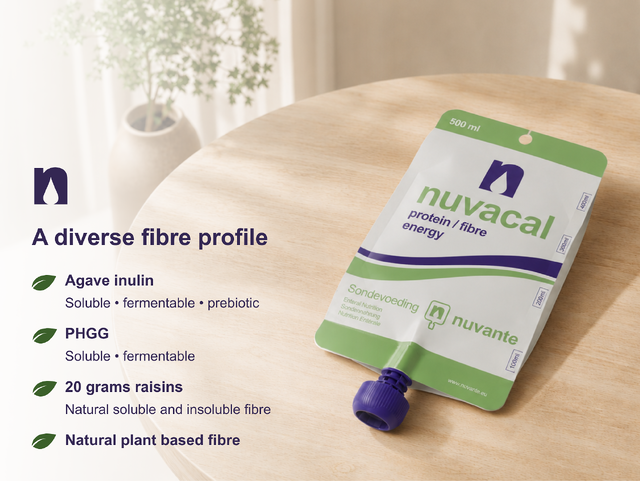
Gastrointestinal tolerance is an important development objective. Both formulas contain inulin and partially hydrolysed guar gum (PHGG): soluble, fermentable fibres with different functional properties. Research into fibre-containing enteral nutrition suggests that adding fibre may contribute to more balanced bowel patterns and a lower incidence of diarrhoea in certain patient groups. Research into food-based and blenderised feeding approaches also indicates potential improvements in gastrointestinal symptoms for some patients.
When developing our medical nutrition, we combine current scientific insights with the practical experience of healthcare professionals. In this way, we aim to create carefully formulated nutrition that is suitable for everyday care and focused on patients’ quality of life.
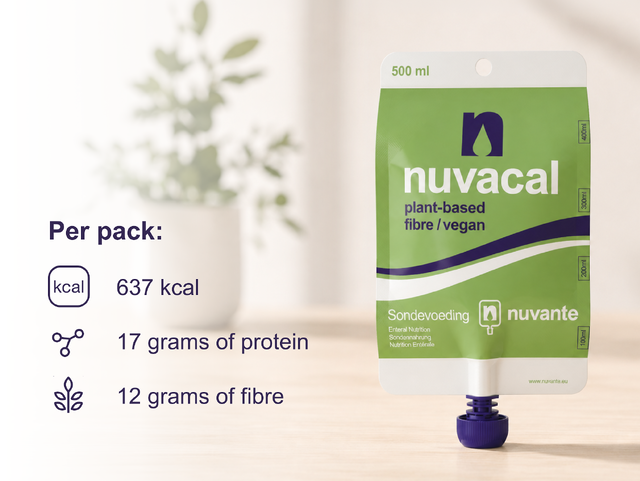
Plant-based, fibre vegan
Nuvacal 1.3
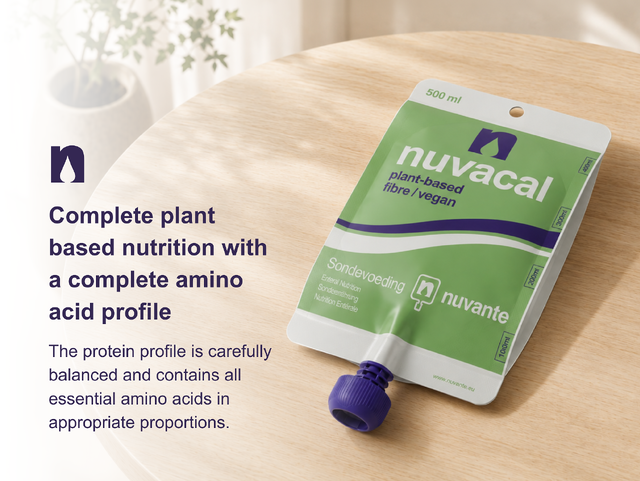
This high-calorie tube-feeding formula combines plant-based ingredients with added amino acids that together contribute to complete and balanced nutrition.
protëin, fibre, energy
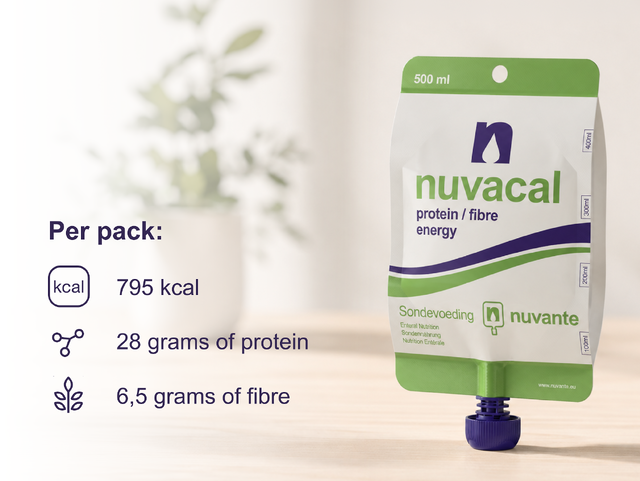
Nuvacal 1.6
This energy-enriched tube-feeding formula combines high-quality milk proteins with carefully selected plant-based ingredients and a balanced fibre and fat profile.
Publications
Scientific background
- Aguilera JM. The food matrix: implications in processing, nutrition and health. Critical Reviews in Food Science and Nutrition. 2019;59(22):3612-3629.
- Miller GD, et al. The importance of food matrix in diet quality and human health. Advances in Nutrition. 2023;14(3):519-532.
- Miguel MV, Haubrick K. Systematic review: exploring outcomes of commercial and homemade blenderized tube-feeding regimens on feeding tolerance in pediatric patients. Nutrition Reviews. 2024;82(9):1208-1215. doi:10.1093/nutrit/nuad118.
- Sforza E, Limongelli D, Giorgio V, et al. The impact of blenderized tube feeding on gastrointestinal symptoms: a scoping review. Applied Sciences. 2023;13(4):2173. doi:10.3390/app13042173.
- Ramuscak AV, Martincevic I, Hulst JM, et al. A scoping review of the clinical outcomes and use of blenderized tube feeds and commercial food-based formulas in pediatrics. Clinical Nutrition ESPEN. 2026;71:102845. doi:10.1016/j.clnesp.2025.102845.
- Kaewdech A, et al. The effect of fiber supplementation on the prevention of diarrhea in hospitalized patients receiving enteral nutrition: a meta-analysis of randomized controlled trials. Frontiers in Nutrition. 2022;9:1008464. doi:10.3389/fnut.2022.1008464.
- Rushdi TATA, Pichard C, Khater YH. Control of diarrhea by fiber-enriched diet in ICU patients on enteral nutrition. Clinical Nutrition. 2004;23(6):1344-1352. doi:10.1016/j.clnu.2004.04.008.
- Epp L, et al. Blenderized tube feedings: practice recommendations from the American Society for Parenteral and Enteral Nutrition. Nutrition in Clinical Practice. 2023. doi:10.1002/ncp.11055.